

Why Marketers Struggle to Achieve Audience Growth in 2026
Audience growth hasn’t disappeared. It has become harder, noisier, less predictable, and far more difficult to measure. Here’s what the latest research says is really going on.
For years, marketers were taught that audience growth came from a familiar formula: publish more, target better, optimize harder, and scale what works. But in 2026, that playbook is under real pressure. Search is changing, social feeds are saturated, AI has made content creation easier but differentiation harder, and many teams still can’t clearly prove what is driving growth. The result is a frustrating paradox: marketers can produce more than ever, yet often struggle more than ever to build lasting audience momentum. HubSpot Sprout Social IAB
The clearest way to understand this shift is simple: audience growth is no longer mostly a content-volume problem. It is now a distinctiveness problem, a discovery problem, and a measurement problem. Brands are fighting for attention in environments where users see more content, trust less of it, and increasingly get answers without ever clicking through. HubSpot Semrush
The real problem isn’t content scarcity. It’s content sameness.
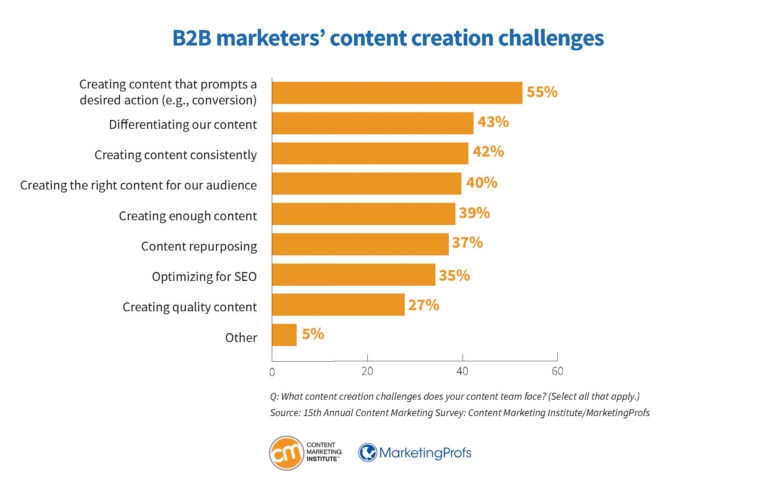
One of the biggest reasons marketers struggle to grow audiences today is that the internet is overflowing with competent but forgettable content. HubSpot argues that AI is now “baseline,” not a differentiator, and that brands without a clear point of view are getting lost in a flood of average output. That idea shows up again in Content Marketing Institute, where 43% of B2B marketers say they struggle to differentiate their content from competitors. When every post sounds polished but interchangeable, reach doesn’t translate into attention, and attention doesn’t translate into growth. HubSpot Content Marketing Institute
This is where many teams misread the moment. AI has made content production faster, but speed alone does not create demand. It often creates more competition for the same finite pool of audience attention. The brands that stand out are not simply publishing faster; they are publishing with sharper perspective, stronger voice, and more obvious relevance. In other words, the growth challenge is less about making more content and more about making content people can instantly recognize as worth their time. HubSpot Content Marketing Institute
Discovery has become harder across both search and social
Even great content now faces a harder distribution environment. In search, Semrush found that Google’s AI Overviews are moving beyond informational queries and appearing more often in commercial, transactional, and navigational searches. In the study period, the share of AIO-triggering commercial queries rose from 8.15% to 18.57%, transactional queries rose from 1.98% to 13.94%, and navigational queries climbed from 0.74% to 10.33%. That matters because those are often the search moments brands care about most for discovery, consideration, and conversion. Semrush
Search marketers should be careful not to oversimplify this into “AI Overviews killed clicks.” Semrush’s research actually found that for the same keywords, zero-click rates decreased from 33.75% to 31.53% after AI Overviews appeared. But that does not mean audience growth is unaffected. It means the battleground has changed. Marketers can no longer rely on ranking alone; they increasingly need visibility inside AI-generated answer environments, where citation, presence, and perceived authority matter as much as blue-link position. Semrush
On social, the problem looks different but feels familiar. Sprout Social describes today’s environment as one of “peak saturation,” where the traditional awareness-first social playbook is no longer breaking through in the same way. Feeds are crowded, attention is fragmented, and audiences are signaling that they want originality, authenticity, and community over generic brand output. That means growth is harder not because social is dead, but because lazy repetition is no longer rewarded. Sprout Social
More posts do not equal more growth
This may be the most useful lesson for modern marketing teams: publishing more is not the same as growing more. Sprout Social found that even though publishing volume decreased from 2023 to 2024, engagement increased by almost 20%. That is a striking signal that audience growth is not driven by sheer output. It is driven by resonance. Yet many leaders still pressure teams to post more frequently, even when the data shows that higher cadence alone has no clear correlation to stronger business impact. Sprout Social
This is one reason marketers feel stuck. Internally, they are often rewarded for activity more than effectiveness. Externally, audiences are filtering out low-value brand noise. The collision between those two realities leads to a lot of motion that looks productive but does not create meaningful audience expansion. Sprout Social
Many teams still can’t clearly measure what drives growth
Another major obstacle is that marketers often do not have a clean line of sight into what is actually working. Content Marketing Institute found that 47% of B2B marketers say measuring results is a top challenge, while many struggle to attribute ROI and track the customer journey. Sprout Social adds that less than half of marketing leaders, 44%, rate their social teams at an expert level in measuring business impact. And IAB reports that only 40% of companies have defined specific KPIs for AI solutions. When measurement is weak, teams cannot confidently scale the right strategies, defend budget, or learn fast enough to compound audience growth. Content Marketing Institute Sprout Social IAB
Measurement problems are not just analytics problems. They are strategic problems. When a team cannot distinguish between content that earns fleeting attention and content that builds lasting audience value, it tends to default to short-term signals. That usually means chasing immediate conversion metrics while underinvesting in the kind of brand-building that makes future acquisition easier and cheaper. Think with Google
Short-term optimization is quietly weakening long-term growth
That short-term bias shows up strongly in current research. Think with Google reports that marketers focused mainly on short-term gains may be missing as much as half of their potential returns. The recommendation is not to abandon performance marketing, but to restore balance: Google/WARC suggests that the “sweet spot” is often 50–60% of marketing spend allocated to brand building, with 40–50% going to performance tactics. When brands over-rotate toward short-term efficiency, they may preserve today’s metrics while undermining tomorrow’s audience growth. Think with Google
The same research notes that a 1% increase in brand awareness can lead to a 0.4% increase in short-term sales and a 0.6% increase in long-term sales. That is a useful reminder that audience growth is not just a top-of-funnel vanity metric. It is part of the mechanism that drives future revenue. Brands that ignore that relationship often discover too late that performance marketing becomes more expensive when brand memory is weak. Think with Google
The back-end infrastructure is often not built for growth
Even when strategy is sound, many teams are still operating on shaky foundations. IAB found that 58% of respondents cite data quality or accessibility issues, while 55% cite fragmented tech capabilities. Sprout Social similarly found that the leading reason teams struggle to understand social’s impact is incompatibility between social tools and the broader marketing tech stack. If customer data is incomplete, workflows are disconnected, and systems cannot share clean signals, then targeting, personalization, attribution, and campaign learning all suffer. IAB Sprout Social
This is also why AI adoption has not automatically solved growth. Content Marketing Institute reports that 81% of B2B marketers use generative AI, but only 19% say it is integrated into daily workflows. IAB adds that 70% of organizations have not fully scaled AI across planning, activation, and analysis. AI can accelerate production and improve efficiency, but it cannot compensate for bad inputs, weak governance, unclear goals, or fragmented systems. In many cases, it simply produces more output inside the same broken operating model. Content Marketing Institute IAB
Audience growth problems are often operating-model problems
One of the most revealing findings in current B2B marketing research is that many growth obstacles are operational, not merely creative. Content Marketing Institute found that 54% of marketers cite lack of resources, 45% lack a scalable content creation model, 42% point to unclear goals, 39% say content is not tied to the customer journey, and 29% report ineffective audience research. That is not just a content issue. It is a planning issue, a resourcing issue, and a strategic alignment issue. Content Marketing Institute
In other words, many marketers are not failing to grow because they lack ideas. They are failing because their systems make consistency, relevance, and learning difficult. Without clear goals, strong audience insight, and a model for scaling what works, growth efforts become reactive rather than compounding. Content Marketing Institute
So why do marketers struggle to achieve audience growth?
Because the environment has changed faster than most operating models have. The old levers still matter, but they do not work the way they used to. Publishing more is less effective in saturated channels. Ranking in search matters, but presence in AI-generated answer experiences now matters too. Targeting is harder when data is fragmented. Content scales faster with AI, but sameness scales too. And when measurement is weak, teams often double down on activity instead of insight. Semrush Sprout Social IAB
The marketers who break through will likely be the ones who stop treating audience growth as a volume game and start treating it as a systems game. That means sharper differentiation, stronger brand investment, cleaner measurement, better audience research, and distribution strategies designed for how people actually discover information now. Growth is still available. But it belongs less to the loudest brand and more to the clearest, most trusted, and best-instrumented one. HubSpot Think with Google Content Marketing Institute
Suggested visuals to embed in the post
You can place these directly into the article:
Hero / intro visual
Source: HubSpot
Search-disruption chart
Source: Semrush
Content-operations chart
Source: Content Marketing Institute
Measurement-friction chart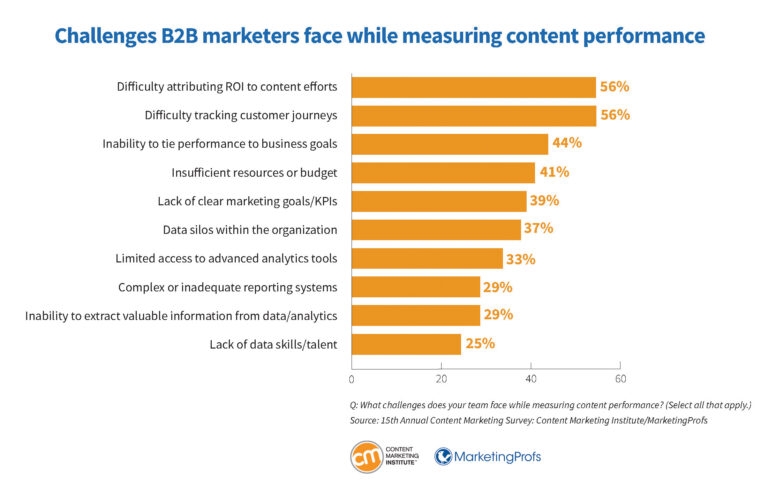
Source: Content Marketing Institute